The Lovecraft mythos is the brainchild of early 20th-century author, H.P. Lovecraft. They are spread across sixty pieces of literature, most of them being short stories with the exception of three short stories and several novellas. These short stories are considered to be the genesis of a new kind of horror mixed with traditional elements of the supernatural and the modern elements of science fiction. The horror was taken away from earthly beings such as ghosts, vampires, and Frankenstein’s monsters and given to gods and surreal beings in the unexplored vastness of intergalactic space. This radical approach was not popular in Lovecraft’s life, leading to a sad death in 1937 plagued with poverty, having led an equally miserable life some would argue. A revival of his work attempted by scholars long after his death proved to be successful, and his work came to be considered a pillar of cosmic horror. His legacy lives on to this date and has resulted in countless movies, TV shows, games, and books influenced by or directly drawn from the Lovecraft mythos. In this essay, I will be focusing on my favorite work by Lovecraft, The Color Out of Space.
The Color Out of Space was written in March 1927, soon after Lovecraft’s move to Providence. It follows a narrator who remains unnamed and his investigation into an area shunned by locals located in the hills to the west of the fictional town of Arkham, known simply as “blasted heath”. No one in the area wishes to talk about it except for an old almost senile man known as Ammi Pierce. He recounts that a meteorite crashed into the property of Nahum Gardner in June 1882. Scientists arrive and observe strange phenomena such as samples disappearing overnight and the stone is soft enough to be crushed with a hammer. While collecting a second sample, they find a globule emitting a peculiar color that could barely be described as one due to not existing on the visible spectrum. One thundery night, the meteorite completely vanishes seemingly from the lightning striking it.
The meteor despite being gone, affects Gardner’s crops, making them huge and abundant but turning them grey, brittle and inedible. The livestock also begins to take peculiar forms and die off, the meat turning out to be inedible. This disease spreads to Gardner’s wife first, making her mad. This results in her being locked up in the house’s attic, soon after followed by his son, Thaddeus. The well’s water goes bad and the other son, Merwin, vanishes while drawing water. Gardner cut off all connections with outsiders except for Pierce.
Pierce visits the farm after a long period of no contact and finds Nahum has also gone insane. When asked about the last sane son, Zenas, Nahum says he lives in the well. Pierce finds Mrs. Gardner heavily deformed in the attic and kills her as an act of mercy. Although there is no explicit mention of the killing, it is heavily implied. When he goes back up, he finds Nahum to also be heavily deformed. In his lucid words, he tells Pierce that The Color from the meteorite is responsible for the sapping of life from the area.
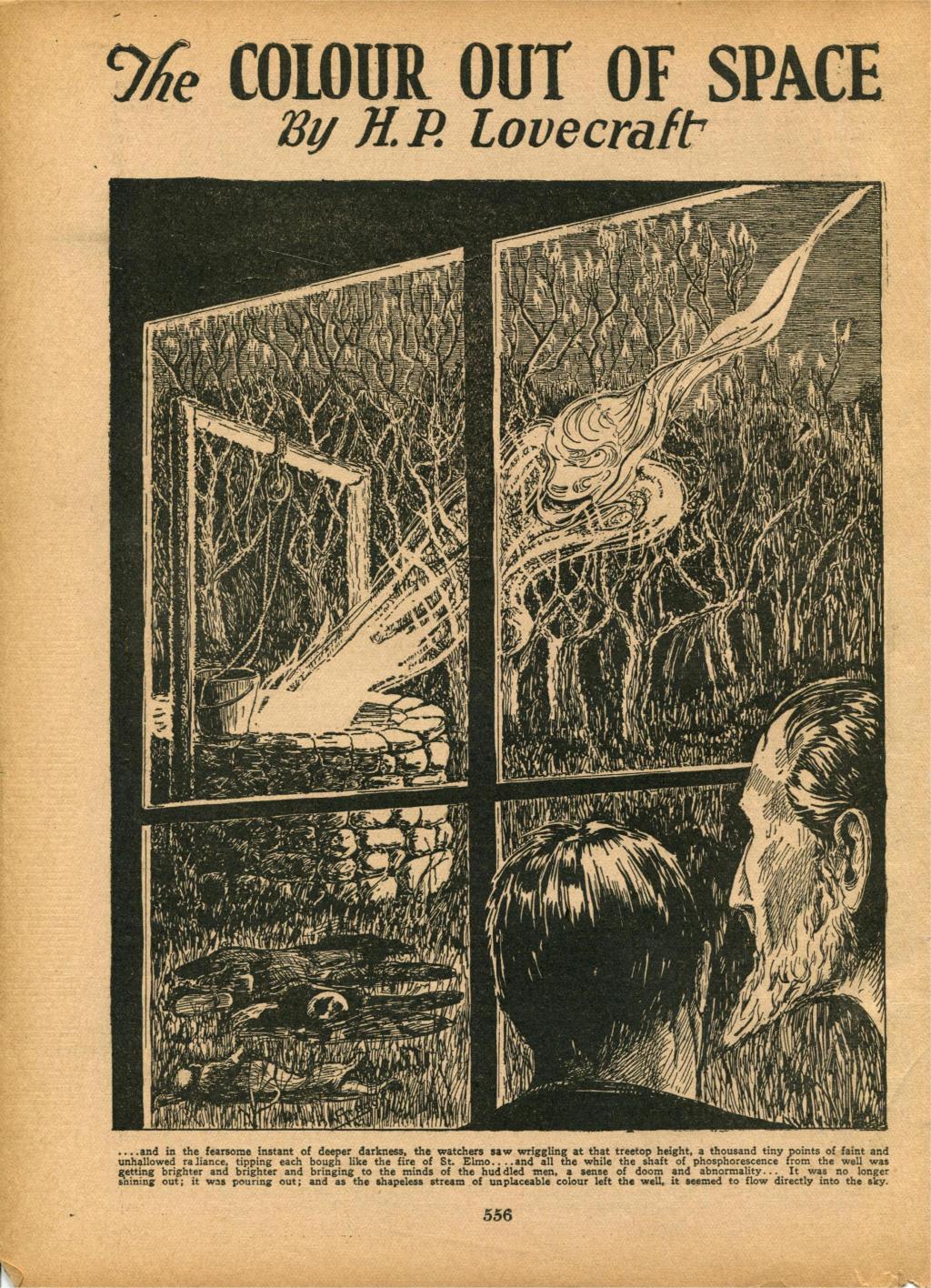
Pierce leaves the farm and returns with six other men. As Nahum said, they find Merwin and Zenas’s corpses at the bottom of the well but not without other skeletons of strange creatures not known to them. As they ponder over their findings of the house, the strange color floods out of the well and begins emitting from all the organic matter in the farmhouse. The trees begin to convulse as the light ascends from the well into the sky, ultimately stopping. The men flee at this sight, and only Pierce remains to witness a small quantity of light attempting to rise from the well and fail. The knowledge that the light remains on the Earth is enough to shatter his mental frame. The men who arrive to investigate the next day find only Pierce’s dead horse and untouched organic matter.
Throughout the story, Lovecraft painted The Color as the protagonist of the story. He reimagined the most basic visual property into a plot device. The Color itself never exists outside of anything. Instead, it appears in the form of a consequence and leaves behind its effects. The trees begin to sway in the night after they begin to glow with The Color, and the vegetation starts to make the livestock that eats it biologically peculiar. All the horses die without any discernible reason and the milk from the cows is not drinkable at all. The monster in the story is never seen but manifests itself in ways that are infused with man and nature. The Color also creates a literary atmosphere of dread and evil. Lovecraft heavily relies on describing the nature and qualities of the world he builds, and in this story, he uses Color to describe any peculiar and “weird’ qualities given to nature.
The Color also works as a metaphor for the literary atmosphere. The literary atmosphere encompasses the feelings and tone involved throughout the work. Lovecraft has always paid very close attention to the atmosphere involved in all his works yet very few people have critically analyzed them. The general atmosphere in most supernatural works is created by the realization that there are things working beyond the perception of the reader. It manifests itself in different forms across supernatural genres but often, it materializes in the form of antagonists such as ghosts, vampires, or creatures of the sort. However, Lovecraft‘s atmosphere is created by the idea that the human mind is in a frightful position because it can’t perceive the horrors that lie beyond. Human existence is prone to fall into universal and existential madness.
Lovecraft also created elements to help build his mythos. The town of Arkham is a fictional town in Essex County, Massachusetts. It is a New England-type setting and combines real and fictional places to be featured in Lovecraft’s works and Cthulhu Mythos by other authors. This type of geographical setting has been given the name “Lovecraft Country” and is a prominent method to set stories in. The men who arrive to investigate the meteor are from Miskatonic University, another fragment of fiction featured extensively in Lovecraft’s works. The scholars working there are supposed experts in the weird creatures and happenings featured in the tales. They act as a form of explanation and entry point to the reader. There is also an element of pseudo-science as an attempt to explain the mystery, but it always falls short since they are beyond the perception of humans.
A unique take on the classical supernatural genre and extensive literary atmosphere has made Lovecraft a pioneer of cosmic literature. His stories are layered with beautiful artform but also build upon the existential dread of humanity. A combination of these qualities has ultimately led to the Lovecraft mythos becoming one of the most popular works in the supernatural genre. Lovecraft himself has become a pillar in the weird fiction genre and his work has had an influence on two generations of horror media. The Lovecraft Mythos will always hold the supernatural world in great influence.


 The Ghost in Our Shells